Sub-Zero vs Viking: how the two compare in a working kitchen — what is the short version?
A fair look at Sub-Zero and Viking: refrigerator design, Viking's ranges, the parts that wear on each, and what service and repairs cost.
Independent · Multi-brand
Northeast Florida
Mon–Fri 8–6 · Sat 9–4
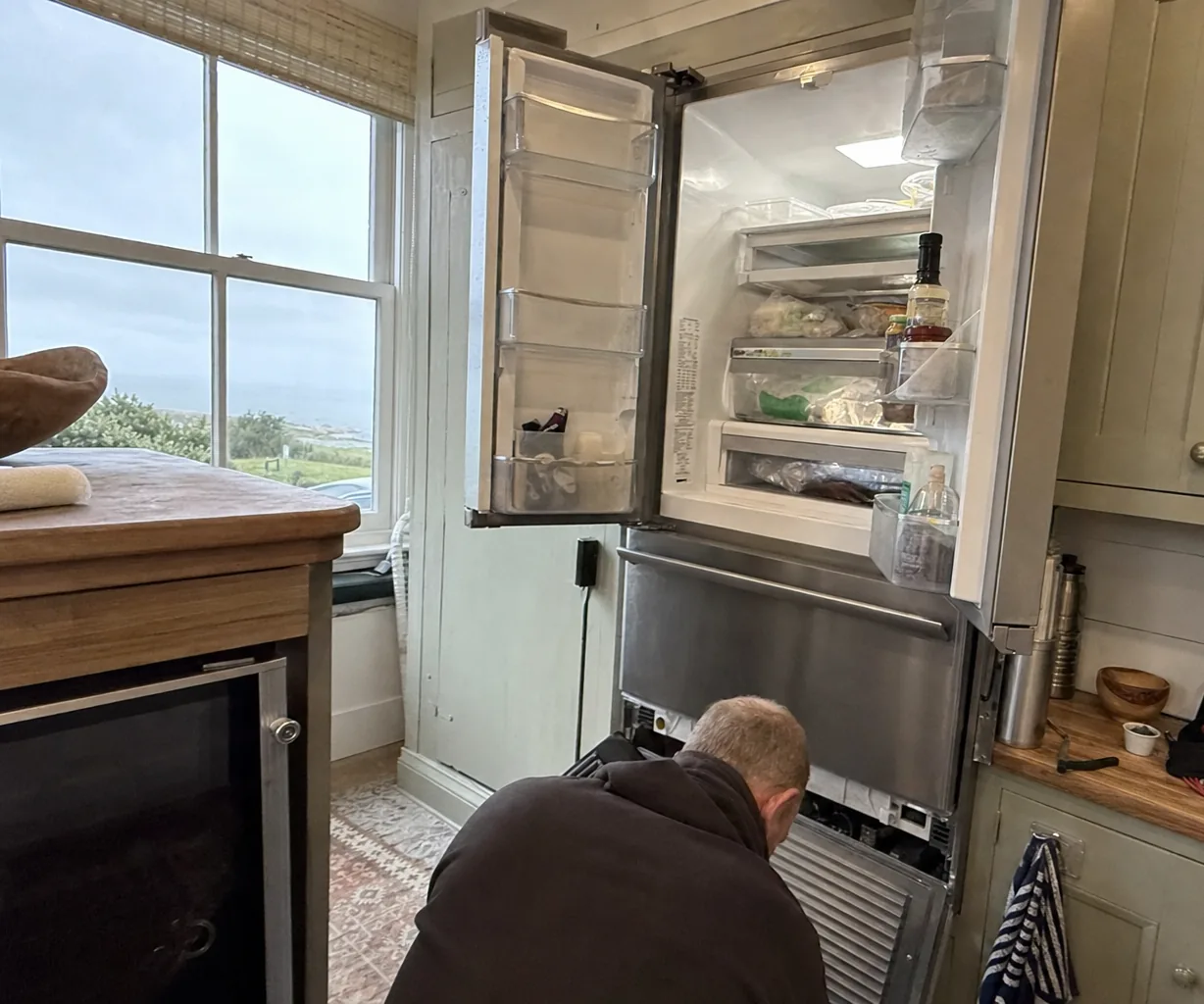
If you are weighing Sub-Zero vs Viking, the short answer is that the two brands solve different problems. Sub-Zero builds nothing but refrigeration, and its Classic line gives the fresh-food and freezer sections their own separate cooling systems. Viking makes refrigerators too, but it is better known for pro-style gas ranges, so it suits owners who want one name across the whole kitchen. For a built-in refrigerator on its own, Sub-Zero is the specialist; for a matched range and fridge from a single maker, only Viking offers both.
Sub-Zero’s catalog is all cold storage: full-size built-in refrigerators and freezers, columns and undercounter models, which carry the UC prefix in its model key. For cooking, Sub-Zero owners usually turn to the sister brand Wolf or mix in another maker. More on our Sub-Zero page.
Viking covers both sides of the room. Its 5 Series freestanding ranges run from 30 to 60 inches wide in sealed-burner gas (VGR), open-burner gas (VGIC), dual fuel (VDR), electric (VER) and induction (VIR) versions, and the same series names appear on its built-in refrigerators. A Viking buyer can match finishes and knobs across range, hood and fridge, which some homeowners value in an open-plan kitchen. Our Viking page lists what we handle.
Sub-Zero renamed its lines in March 2019: the Built-In series became Classic, the Integrated series became Designer, and PRO kept its name. That is why older units carry legacy prefixes such as BI and BW, or IT, IC, ID and IW, while current models use CL for Classic and DET, DEC or DEU for Designer.
Classic comes in 30, 36, 42 and 48 inch widths with a flip-up grille across the top, and Sub-Zero suggests it when the unit will stand alone or have a side partly showing. Designer comes in 24, 30 and 36 inch widths, puts the grille down low, and hides behind cabinet panels so very little metal shows. In the Classic line, Dual Refrigeration gives the refrigerator and freezer their own systems, so fresh-food smells never reach the ice and the fresh-food side keeps its moisture instead of being dried out.
Viking uses a similar idea at the top of its lineup. The 7 Series built-in refrigerators run two compressors so each compartment works independently, while the 5 Series uses one variable-speed compressor with the ProChill system. Viking states that both hold within 1 degree of the temperature you set.
A 5 Series gas range uses sealed burners rated at 15,000 BTU on natural gas, or 12,500 BTU on LP, and some models add a TruPower Plus burner at the front right rated 18,500 BTU on natural gas or 16,600 BTU on LP. The 7 Series steps up to Elevation Burners: 23,000 BTU burners along the front of every width, with several 15,000 BTU burners and one 8,000 BTU burner across the back. Because those ports sit raised, boil-overs are less likely to bake on.
Viking’s gas ovens, fitted with the Gourmet-Glo infrared broiler, are aimed at broiling and single-rack baking. Its electric ovens, with Vari-Speed Dual Flow convection, are the better pick when you bake on several racks at once.
Both brands build heavy, long-lived equipment, and most repairs on either are wear items rather than design flaws. On built-in refrigerators the usual suspects are door gaskets that stop sealing, condenser and evaporator fan motors, defrost parts and ice maker water valves. A clogged condenser is the most avoidable problem: on a Classic the coil sits behind the top grille, on a Designer behind the lower one, and dust there makes the compressor run longer. Long, humid Northeast Florida summers add load as well, since every door opening lets in moist air the system has to pull back out.
On Viking ranges, typical calls involve igniters, spark modules, burners that light slowly because spills have blocked the ports, and oven temperature sensors. Wiping up boil-overs promptly prevents a good share of them.
Sealed-system work on newer refrigerators has also changed. In 2018 the EPA adopted the 2017 UL 60335-2-24 standard, which lets each refrigerant circuit in a household refrigerator or freezer hold up to 150 grams (5.29 ounces) of R-600a, R-290 or R-441A, up from the old 57-gram cap. Those refrigerants are flammable, so a leak or compressor job belongs with a technician equipped for them.
We are an independent service working across Jacksonville, Duval, Clay and St. Johns counties and the Jacksonville Beaches, and we fit genuine OEM parts. Every visit starts with the $80 diagnostic. As typical ranges, a door gasket or seal replacement runs $240–$600, an evaporator or condenser fan motor $280–$600, and an igniter, spark module or surface element $200–$570. You get the firm figure once the fault is diagnosed, and the pricing page lists the other bands. A typical replacement unit at this level lands in the $8,600–$19,400 range, so a worn gasket or failed fan is rarely a reason to start over.
Whichever you choose, keep the model and serial numbers handy, vacuum the condenser grille a couple of times a year, and replace a torn gasket early. Our built-in refrigeration page covers the cooling side in more detail.
Published
· updated
One fee to find out: $80, flat, and it comes off the bill the moment you say go ahead. Past that, the repair work this guide describes sits between $240 and $600, and where inside that band a job lands is decided by the part that failed rather than by the badge on the door.
Narrowed to the failures this guide is about, so the table is shorter than the one on the pricing page.
| Repair | Parts and labor |
|---|---|
| Diagnostic visit, flat | $80 |
| Evaporator or condenser fan motor | $280–$600 |
| Door gasket or seal replacement | $240–$600 |
You get a written estimate before any part is ordered or any labor begins. Nothing proceeds without your approval.
A fair look at Sub-Zero and Viking: refrigerator design, Viking's ranges, the parts that wear on each, and what service and repairs cost.
$80 to come out and find the fault, credited back the moment the repair is approved. The work itself lands between $240 and $600 on this kind of equipment — $280–$600 for evaporator or condenser fan motor, $240–$600 for door gasket or seal replacement — and which of those it turns out to be is the thing the visit settles. Your own number goes in writing before a part is ordered.
Duval County, St. Johns County, Clay County, Nassau County. Roughly a 40-mile working radius from the Jacksonville core. $80 flat diagnostic fee, credited toward the repair when you approve the work.
You get a written estimate before any part is ordered or any labor begins. Nothing proceeds without your approval.