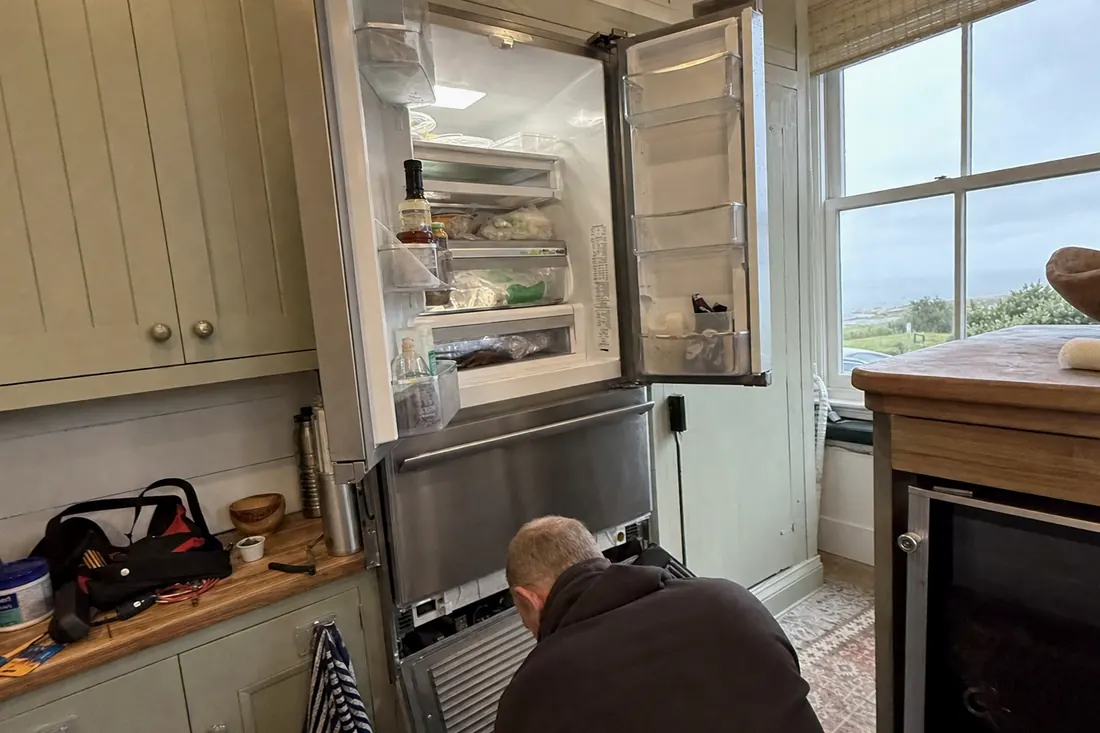
The far side of the grid
Clay County reads as suburban Jacksonville from the outside. For appliance work its
defining features are grid position, garage space and the age split between the
older river housing and the newer subdivisions inland.
In a widespread outage, this side of the river is not usually first in the
restoration order. Matthew took power from nearly 250,000 metro customers in October
2016 and Helene took 113,000 JEA customers off the grid in September 2024. A longer
outage means more appliances sitting connected when the power finally returns, and
the damage arrives with the restoration rather than during the dark.
Control boards, inverter compressor drives and oven electronics fail on the way back
up far more often than they fail while the power is off. The habit that prevents most
of it costs nothing: open the breaker on built-in refrigeration once the power has
already failed, and restore it manually about twenty minutes after the street is
stable.
Garage and outbuilding refrigeration
Oakleaf Plantation and the newer Clay County subdivisions have deep garages, and a
second refrigerator or freezer in an unconditioned garage is common — usually the
appliance that was in the kitchen before the last remodel.
That unit is the one most likely to fail quietly at the worst possible moment.
Domestic refrigeration is specified to work within a range of ambient room
temperatures, and an unconditioned Northeast Florida garage spends whole summer
afternoons outside that range. Meanwhile its condenser has been collecting dust,
lint and whatever the garage door lets in since the day it was installed, because
nobody schedules maintenance for the beer fridge.
Put those together and the machine runs longer for less, loses capacity gradually
through the summer, and gives out when the house is full for a holiday. Clearing the
fin stack twice a year is the whole intervention, and it is the first thing we check
at an address here.
Humidity, at full regional strength
Nothing about Clay County softens the air. Mean relative humidity runs about 75
percent, the region takes roughly 53 inches of rain a year, and properties around
Doctors Lake and along the St. Johns sit beside a lot of open water.
Refrigeration door seams sweat, gaskets grow mould in their folds, and defrost
systems fall behind once a gasket has taken a set and stopped sealing evenly. That is
the most common refrigeration call we take on this side of the river, and it is
frequently mistaken for a failing compressor. A gasket, a hinge adjustment and a
defrost check cost a fraction of what the assumed diagnosis would have.
Gas cooking has its own humid-weather signature: a burner that clicks without
lighting after a run of wet weather is usually moisture and residue in the port
rather than a failed igniter, and cleaning the port and drying the electrode fixes it
more often than a part does.
Older Orange Park housing
Along the river and through the older parts of Orange Park and Hibernia Plantation,
kitchens have been remodelled around appliances rather than designed for them.
Retrofitted dishwashers with drain lines that were never looped correctly produce
standing water in the sump — read by nearly everyone as a failed pump, and usually
not one. Undersized cabinet openings and missing dedicated circuits show up in the
same houses.
Where replacement is the honest recommendation, the opening decides what will fit.
We measure it during the diagnostic instead of after the order, and we work out how
the appliance gets from the street to the kitchen before anything is unbolted.
Repair or replace, on this side of the river
A garage refrigerator and a fitted kitchen column are different economic questions,
and we answer them differently. A free-standing unit in a garage is worth repairing
while the repair is cheap and the cabinet is not involved; once the cost approaches
a large share of replacement, replacing it is the honest recommendation and we will
say so on the estimate.
A built-in is the opposite case. It was fitted to a specific opening, it carries a
custom panel, and replacing it frequently means cabinet work as well as an appliance
purchase — so a repair that would be marginal on a free-standing machine is usually
worth doing on a built-in. The decision turns on the cost of the part, the age of
the platform and whether the part is still supported, and all three of those go in
writing before anything is ordered.
What gets called in on this side of the river
Five kinds of machine account for effectively every Clay County booking, and they are
the same five everywhere else we work: built-in refrigeration, undercounter ice
machines, dishwashers, wall ovens and ranges, and cooktops with the hood above them.
Orange Park and Fleming Island weight that list differently from the beaches — more
garage and utility-room refrigeration, more retrofitted dishwashers, fewer outdoor
kitchens — but nothing outside it. Out towards Middleburg and south to Green Cove
Springs the lots get larger and the grid position gets worse, which pushes surge
damage further up the list again.
What we are not is the other half of a house’s machinery. Heating, air conditioning,
heat pumps and ductwork are a separate trade here as everywhere, and a Clay County
homeowner with a dead air handler in August is better served by being told that in
the first thirty seconds of the call than by a technician who arrives and cannot
help. Laundry is not ours either. Everything above is, at every address from the
river out to Middleburg.
Working in Clay County
Scheduled appointments Monday to Friday 8am to 6pm and Saturday 9am to 4pm, within a
roughly 40-mile working radius from the Jacksonville core. We are an independent
appliance repair company, and sealed-system work is run by an EPA Section 608
certified technician as federal law requires.
$80 flat diagnostic, credited toward the repair when you approve it, and a written
estimate before any part is ordered. Genuine OEM parts, 90 days on labor, 365 days
on parts.