Skip to content

Independent · Multi-brand

Northeast Florida

Mon–Fri 8–6 · Sat 9–4

Heat rejection is what limits this category first.

Ice machine and ice maker repair

An ice machine runs a freeze cycle and a harvest cycle against a Florida summer. Which of the two has stopped working decides the whole diagnosis.

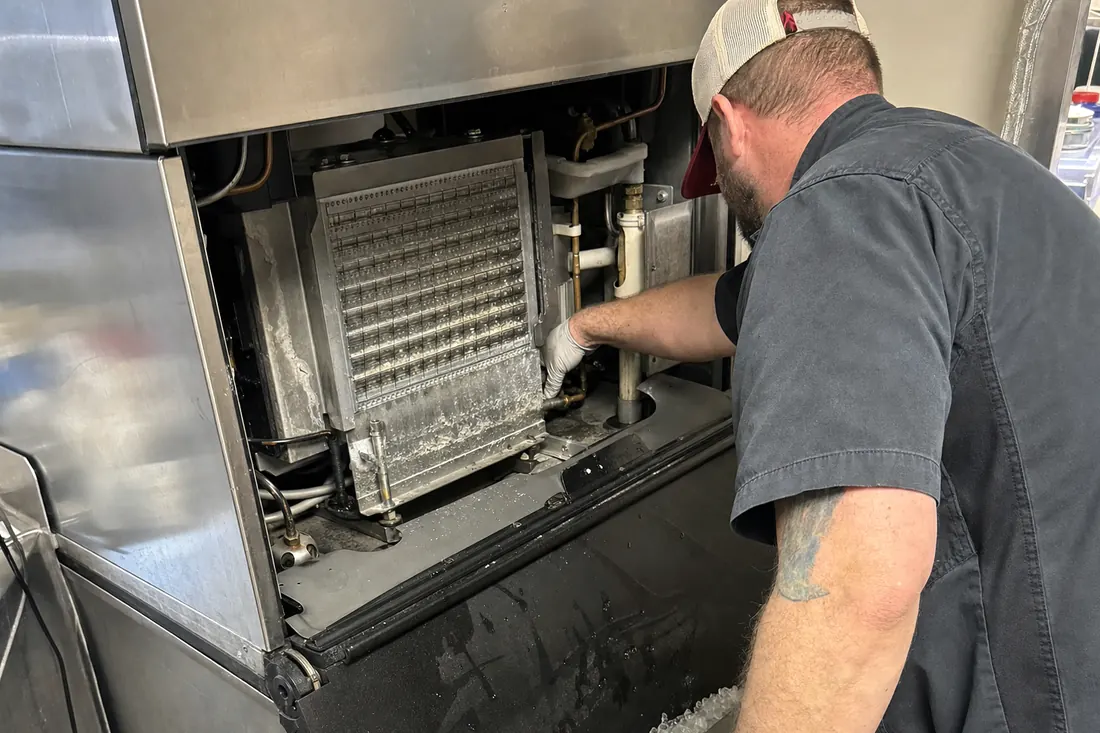
Technician at a stainless ice machine with the top panel off, checking the water line and the evaporator plate, the water line in frame - Ice machine and ice maker repair

Two cycles, and only one of them is usually broken

An ice machine does two separate things in sequence. It freezes water in thin layers onto a plate — the freeze cycle — and then warms that plate just enough for the batch to release into the bin under its own weight, which is the harvest cycle. Almost every complaint we are called to is a failure of one or the other, and telling them apart is most of the diagnosis.

A freeze-cycle problem produces bad ice: thin, hollow, cloudy or soft cubes, made at roughly the normal rate. A harvest-cycle problem produces good ice that will not come off the plate: cubes fused into a slab in the bin, or a machine that fills, freezes, warms, tries again and never delivers. A production problem — good ice, correctly released, just not enough of it — is usually neither, and is usually about heat.

Heat rejection is the quiet one

The part of an ice machine most likely to be the actual cause is the part nobody looks at. Every calorie the machine takes out of the water has to go somewhere, and on an undercounter unit it goes out through a fin stack behind the grille, a few inches above the floor.

That is the worst location in the kitchen for an air intake. The stack loads with dust, pet hair and cooking aerosol, the insulation that debris forms is exactly what a condenser cannot tolerate, and the machine responds by lengthening the freeze cycle to compensate. Production drops first. Cube quality goes next. Eventually the compressor is running against pressures it was never meant to hold for a whole summer.

Placement makes it worse or better. A machine in an outdoor kitchen or a garage is rejecting heat into air that is already hot, in a confined space, all afternoon. A machine boxed into a cabinet run with no return path is re-breathing its own warm discharge. Neither of those is a fault in the appliance, and neither is fixed by replacing a component.

The water path, filter and fill

Water reaches the plate through an inlet valve, a filter where one is fitted, and a distribution path that spreads it evenly. Faults here present as uneven batches: some cells full and some short, ice heavier at one end of the plate than the other, or a fill that never reaches the volume the cycle expects.

A filter left in well past its life is the most common single cause. It restricts flow, the fill takes longer than the control allows, and the cycle starts on less water than it needs. This is a ten-minute finding on a diagnostic, and it is worth checking before anything is dismantled.

The local supply is mineral-rich enough that a machine here does need its cleaning cycle run on a schedule with the correct nickel-safe cleaner for the evaporator; the wrong chemical damages a plated plate permanently. Where a machine has been left, a single cleaning cycle often will not recover it, and that is a maintenance conversation rather than a repair.

Drains, leaks and the cabinet underneath

Undercounter machines drain by gravity where the plumbing allows and through a pump where it does not. A gravity drain that has lost its fall, been kinked behind the unit during a floor replacement, or been connected into a line that backs up will put water on the floor of a cabinet, and the cabinet base is usually the first thing damaged.

Water under an undercounter unit is worth acting on the same day. The machine is sitting on it, the panel-ready cabinetry around it absorbs it, and a leak that is a hose clamp on Monday is a cabinet repair by the following month.

Storms, boards and the electrical side

An ice machine contains a control board, a water valve and, on most units, a compressor with its own electronics. All of that is exposed when a neighbourhood is re-energised at once after an outage. If a machine went silent the morning the power came back rather than during the storm, the fault is electrical and the water side is a red herring.

Coastal installations add corrosion to the same list: chloride-laden air pits stainless and eats aluminium fin stacks, which brings us back to heat rejection by a different route. A monthly fresh-water rinse of an exposed fin stack costs nothing and buys years.

What a visit includes

We check the airflow path and the condenser first, then the fill: inlet flow, filter condition and age, and fill volume against what the cycle expects. Then the cycle itself — freeze time, harvest time, plate temperature and the state of the plate. Then, and only if the cycle is genuinely faulty, the components.

The visit is an $80 flat diagnostic, credited toward the repair on approval, with a written estimate before any part is ordered. Genuine OEM parts, 90 days on labor, 365 days on parts.
Before · during · after
  1. before

    Before anything goes wrong

    Pull the grille and look at the condenser. An undercounter ice machine rejects the heat it removes from the water through a fin stack a few inches off the floor, in the part of the kitchen that collects the most dust and pet hair. Clearing that stack, and keeping the drain line and the filter on a schedule, prevents more failures on this appliance than any other maintenance in the house.

  2. during

    During normal running

    Watch the cube, not the machine. Clear, solid, fully formed cubes mean the freeze cycle and the harvest cycle are both completing. Hollow or cloudy cubes mean the freeze is being cut short or the water is not being distributed evenly across the plate. Fused slabs mean the harvest is not releasing cleanly. Each of those points at a different part of the system, and the difference is worth stating on the phone.

  3. after

    After a fault has developed

    Switch it off rather than leaving it to try. A machine that fills and never harvests keeps circulating water over a plate it cannot clear, a machine leaking under the counter keeps wetting a cabinet base, and a machine short-cycling in hot air keeps loading a compressor. Shut it down, close the supply valve if there is water on the floor, and let it be diagnosed before more damage accumulates.

What it costs

What does ice machines repair cost?

One fee to find out: $80, flat, and it comes off the bill the moment you say go ahead. Past that, work on ice machines across this coast sits between $240 and $2,520, and where inside that band a job lands is decided by the part that failed rather than by the badge on the door.

The rows are the repairs this category actually generates, so the table narrows as the subject does.

Parts and labor by repair, ice machines. A band, not a price tag: it is where work of this kind lands in this market, and your own figure goes in writing once the appliance has been measured.
Repair Parts and labor
Diagnostic visit, flat $80
Compressor or sealed-system repair $930–$2,520
Ice maker, water valve or supply line $240–$670
Evaporator or condenser fan motor $280–$600
Electronic control board $440–$990

You get a written estimate before any part is ordered or any labor begins. Nothing proceeds without your approval.

Symptom to figure

How ice machines faults get described on the phone

The same table again, entered from the symptom rather than from the part. Nobody rings up asking for a defrost heater; they ring up because something is wrong and they want to know what it is going to cost.

Every figure below is a row of the table on this page, narrowed to the repair the symptom leads to. The $80 diagnostic decides which row you are actually in, and it comes off the bill once you approve the work.

What the fault is called on the phone, and where the repair behind it lands. A band, not a quote.
What you would call itThe repair it leads toParts and labor
Ice maker not making iceIce maker, water valve or supply line$240–$670
Ice maker filling with water but not making iceIce maker, water valve or supply line$240–$670
Ice machine leaking water onto the floorIce maker, water valve or supply line$240–$670
Ice maker stopped and the condenser fan is silentEvaporator or condenser fan motor$280–$600
Related storm guides
Asked about this equipment

What does ice machines repair cost in Northeast Florida?

$80 to come out and find the fault, credited back the moment the repair is approved. The work itself lands between $240 and $2,520 on this kind of equipment — $930–$2,520 for compressor or sealed-system repair, $440–$990 for electronic control board — and which of those it turns out to be is the thing the visit settles. Your own number goes in writing before a part is ordered.

Which ice machines faults do you take calls about?

Most often: cubes coming out hollow, cloudy or soft instead of clear and solid; cubes fusing into a slab in the bin rather than releasing separately. If your symptom is not on that list, describe what the appliance is doing rather than naming a part — the diagnosis then starts from a measurement instead of a guess.

What happens if the repair does not hold?

Our own work carries 90 days on labor and 365 days on the parts we fit, and we fit genuine OEM parts only. That is our warranty rather than a manufacturer warranty, and it neither extends nor replaces one. If the same fault comes back inside those terms, the return visit is ours.

Customer feedback

After a call about ice machines

Rated 4.6 out of 5 across 101 customer reviews. Every entry below is one appointment, written up afterwards by the householder whose kitchen it happened in.

Filed under this category, so these are visits to this kind of equipment.

  • Production had halved over the summer and the unit sat in a bar cabinet with almost no air. He cleaned the fin stack, freed the grille and explained the clearance problem. Better, though not what it was when new.

    Barnaby H.2026-01-30

  • Production had been falling all summer and the machine sits in an outdoor kitchen. He cleaned the condenser, replaced the fan motor and was honest that the heat here will always make this unit work harder.

    Leopold S.2025-10-23

  • Nothing at all from the machine after the power came back. He found the board had lost a relay to the spike, fitted the replacement and checked the circuit feeding the cabinet before signing off.

    Isadora M.2026-02-18

More of the 101 published entries

Book a diagnostic

You get a written estimate before any part is ordered or any labor begins. Nothing proceeds without your approval.