Which Viking this is
Viking Range, the Greenwood, Mississippi maker of professional-style kitchen
equipment, builds ranges, rangetops, wall ovens, cooktops, ventilation, built-in and
undercounter refrigeration, wine storage, ice machines, dishwashers and outdoor
grills. That is the Viking this page is about, and a kitchen is the only place you
will find us working on one.
It is worth saying plainly, because the name is not unique: there is also a Viking in
Indian River County, about two hundred miles south of Jacksonville, and people
looking for a furnace or an air-conditioning contractor down there keep landing here.
We are not that. We do not repair furnaces, air handlers, heat pumps or ductwork
anywhere, under any badge — kitchen appliances are the whole trade, and an HVAC
contractor is who you want for the other thing.
Indoors and outdoors, which is unusual
In Northeast Florida the outdoor half of that product list matters more than it would
almost anywhere else in the country.
A summer kitchen on a lot in Marsh Landing, Isle of Palms or Queen’s Harbour is
exposed to something an indoor appliance never sees: air carrying chloride off the
Atlantic, every day, all year. That single difference reorders the fault list.
Salt air is a materials problem, not a cooking problem
The coastal ZIPs in our area — 32082, 32250, 32266, 32233 and 32084 — sit close
enough to the ocean that airborne salt deposits on any surface with a view of the
sky. Rain does not wash it off; it dissolves it and carries it into seams.
What that does, in order:
- Fasteners and hinges go first. Different metals in contact, plus a chloride
electrolyte, is a galvanic cell. Hinge pins seize, screws round out, and a door
that has to be forced ends up out of alignment.
- Stainless pits. Stainless steel resists corrosion because of a passive oxide
layer, and chloride is specifically good at breaking that layer down locally. The
result is pitting and rust bloom, not uniform tarnish.
- Condenser fins corrode. On an outdoor refrigerator or ice machine, salt
attacks the aluminium fin stack directly. Heat rejection falls, the compressor
runs longer, and the unit slowly loses capacity in the exact season it is needed.
Fresh-water rinsing of exposed stainless and fin stacks on a monthly schedule is
worth more than any repair. It is unglamorous and it works.
Open burners and damp weather
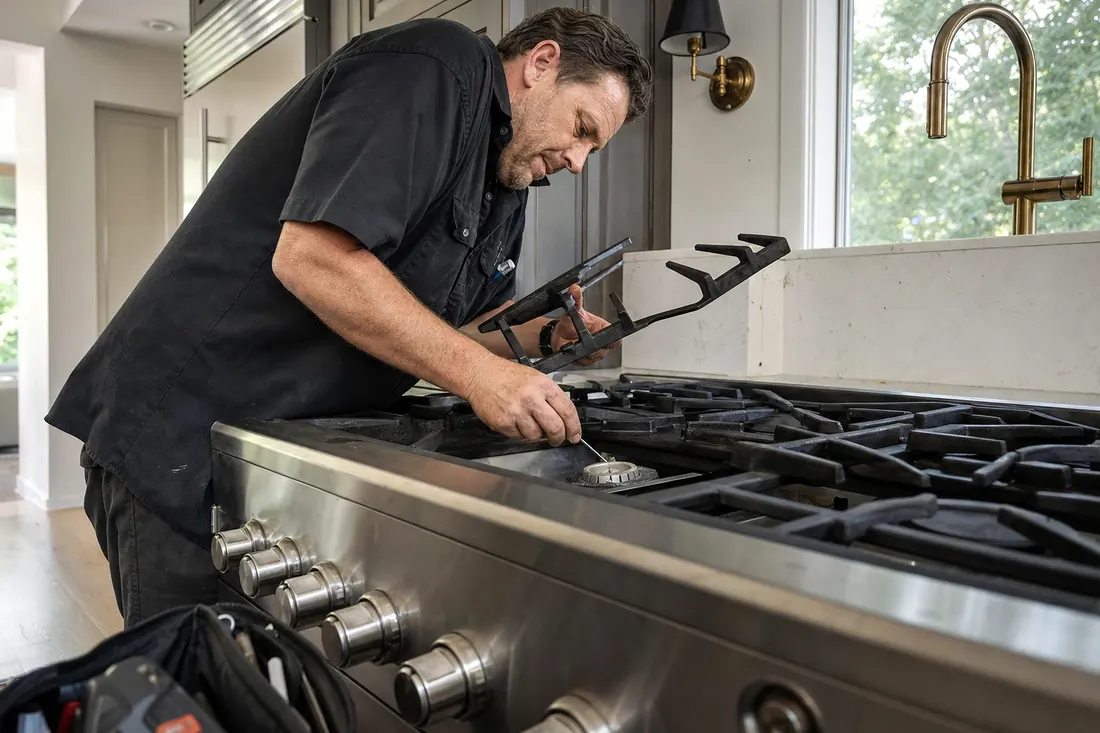
Viking’s open-burner ranges are built to be serviced, which is genuinely useful.
The burner caps, bases and ports lift out for cleaning. In a climate this humid,
they need it: moisture plus cooking residue in a burner port produces a lazy yellow
flame, uneven heat, and a burner that will not light on the first click.
If a burner has gone soft after a run of wet weather, cleaning the ports and drying
the igniter electrode fixes it more often than a part does. If the problem is on
every burner simultaneously, we look at the spark module and the gas pressure at
the manifold with a manometer, not at the burners.
Refrigeration and ice, outdoors and in
Viking built-in refrigeration fails here the way all built-in refrigeration fails
here: a condenser blanketed in lint from a house running air conditioning most of
the year, a gasket that stopped sealing, or a defrost circuit that cannot keep ahead
of the moisture load.
Outdoor and garage installations add the harder version of the same problem. An
undercounter refrigerator or ice machine under a counter in afternoon sun rejects its
heat into hot, still air in a confined space, through a fin stack that collects
whatever the outdoors puts in it. Production falls, run time climbs, and a stack that
would be merely dirty indoors becomes the fault itself. Where the unit is not
specified for an outdoor installation, that gap stops being theoretical in July.
The ice machines are the most demanding thing in the group, because each batch has to
be frozen onto a plate and then released off it by warming that plate. Both halves of
the cycle lengthen when heat rejection is compromised, and the first thing the
homeowner notices is a bin that no longer fills overnight. Clearing the grille and
the fin stack on a schedule prevents more of these calls than any part we fit.
How we work on them
Visits start with an $80 flat diagnostic, credited toward the repair when you
approve the work, and a written estimate before any part is ordered. Genuine OEM
parts, 90 days on labor, 365 days on parts. Sealed-system work is run by an EPA
Section 608 certified technician, as federal law requires.