What makes built-in refrigeration different
A freestanding refrigerator sits in a room. A built-in or integrated unit is a
component of the cabinetry: it is fitted flush, it carries a custom door panel, it
draws condenser air through a grille rather than off an open back, and it is
expected to run for two decades. That construction is why these units are worth
repairing rather than replacing, and it is also why every one of the regional
stressors reaches them.
Across Northeast Florida we service Sub-Zero, Thermador, Miele, Viking and Bosch
built-in and column refrigeration. The brands differ in their controls and their
refrigeration architecture, but the failure mechanisms this climate produces are
shared.
Humidity is the dominant stressor
The regional mean relative humidity is about 75 percent, and through the summer the
dew point sits high for weeks at a time. Refrigeration is fundamentally a
moisture-management problem, and that changes the arithmetic.
At the door seam. Every time a warm, humid room meets a cold liner, water wants
to condense. A gasket in good condition prevents that. A gasket that has taken a set
— flattened along the hinge side, crushed at a corner, or hardened with age — does
not, and the leak is continuous rather than occasional. You see beading on the
cabinet face, then mould in the gasket folds, then a musty smell.
Inside the cabinet. Every gram of water that leaks in ends up as frost on the
evaporator. The defrost system is sized for a normal moisture load. Give it a
continuous leak and it falls behind: frost accumulates behind the rear panel,
airflow through the evaporator drops, the fan starts clattering against ice, and the
fresh-food compartment goes warm while the compressor runs constantly. Homeowners
read that as “losing gas”. It usually is not.
Panel-ready hides the evidence. An integrated unit with a custom front does not
show you a wet gasket. By the time there is a visible symptom, the process has been
running for months.
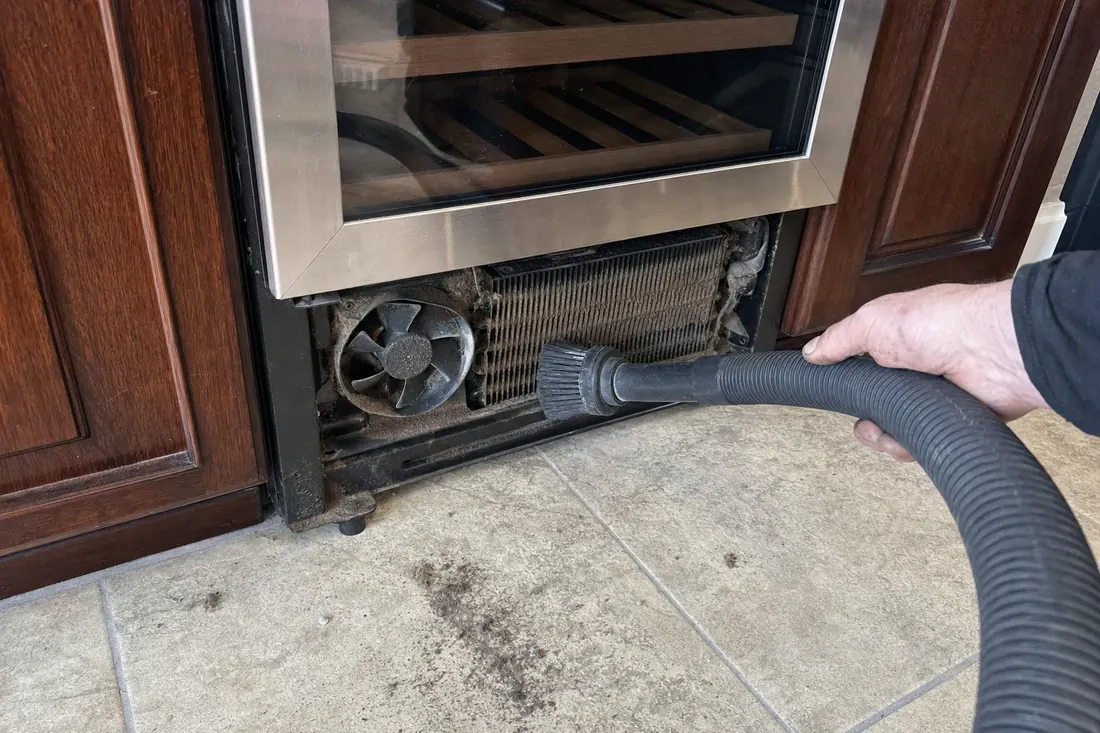
Condenser fouling, the other half
Houses here run air conditioning nine or ten months a year, which means indoor air
is recirculated air, and recirculated air carries lint, dust and pet hair. A
built-in unit’s condenser sits behind an upper or lower grille and pulls that air
through a dense fin stack.
A blanketed condenser cannot reject heat. Head pressure rises, run time lengthens,
the ice maker slows first, and eventually the compartment temperature follows.
Nothing is broken, and yet the unit is failing. In this climate we clean condensers
on roughly a six-month cycle, not annually.
Storms damage refrigeration on the way back up
Matthew took power from nearly 250,000 metro customers in October 2016. Helene took
113,000 JEA customers off the grid in September 2024. In both cases the refrigeration
calls that followed were not about food safety — they were about units that came
back wrong. Control boards, inverter compressor drives and user interfaces are
damaged by the restoration transient far more often than by the outage itself.
The sequence above is what we tell every customer with a built-in unit before
hurricane season. It costs nothing and it prevents the most expensive single repair
on the appliance.
What a visit looks like
We measure before we quote: compartment temperatures at the shelf rather than the
display, evaporator and condenser temperatures, gasket compression at multiple
points, door alignment and self-close, and the state of the defrost circuit. Sealed
system work is run by an EPA Section 608 certified technician, as federal law
requires.
The diagnostic is $80 flat, credited toward the repair when you approve it, and
you get a written estimate before any part is ordered. Genuine OEM parts, 90 days on
labor, 365 days on parts.