Do you cover Jacksonville?
Yes — Duval County, including Deerwood, Deercreek, Glen Kernan, Pablo Creek Reserve. Roughly a 40-mile working radius from the Jacksonville core. Appointments are scheduled, Mon–Fri 8–6 · Sat 9–4.
Independent · Multi-brand
Northeast Florida
Mon–Fri 8–6 · Sat 9–4
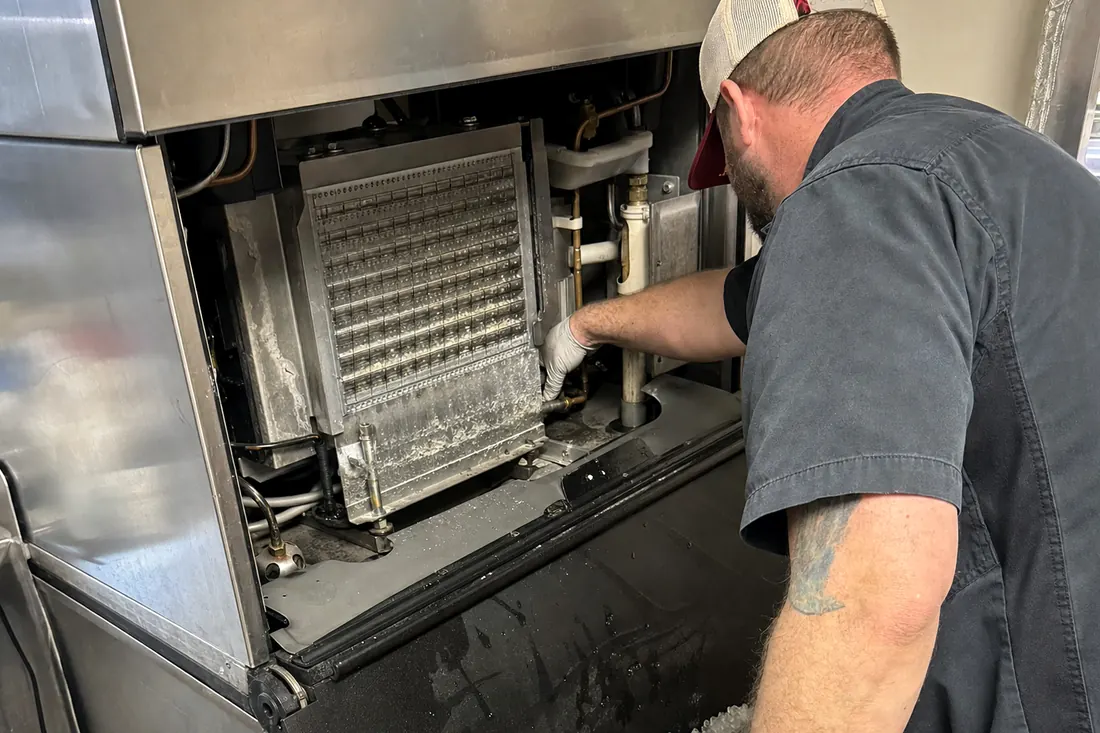
Jacksonville is the only area we cover where a single afternoon can take in a 1920s Riverside kitchen with a 30-inch opening and no dedicated circuit, and a Southside house with four panel-ready built-ins commissioned in the same week.
First checks at an address here
When the kitchen was built
It decides everything downstream: whether the opening was cut for the appliance in it, whether a dedicated circuit exists, and whether a replacement will physically fit.
The condenser airflow path
Grille, fin stack and clearance on every refrigeration unit. In a house running air conditioning most of the year, recirculated indoor air puts lint straight onto the fins.
Door alignment and seal
A heavy panel-ready front loads its hinges hard, and a door that has dropped out of square is a permanent heat and moisture load no sealed system can win against.
Drain routing behind a retrofit
Dishwashers fitted into cabinet runs that never planned for one commonly have no high loop, no air gap, or a disposal knockout plug still in place.
Whether the fault dates from a restoration
If the appliance stopped the morning the power came back rather than during the outage, the diagnosis starts at the board and the interface, not at the sealed system.
That order is not a script. It is where the odds sit at an address in this area, and a technician who finds the cause in the second step stops there rather than working down the rest of the list.
Jacksonville is large enough that treating it as one service area is misleading. The housing stock runs from brick-and-frame homes built between the 1900s and the 1930s along the river, to Southside and Intracoastal construction from the 1990s onward, and the two produce different call sheets.
In the older neighbourhoods the appliance is usually fine and the installation is the problem. In the newer ones the installation is usually correct and the appliance is being asked to work hard, continuously, in a room that never really cools down.
Riverside, Avondale, Ortega and San Marco were laid out before built-in appliances existed. Kitchens have been remodelled around what was available at the time, more than once, and the evidence is in the details.
Cabinet openings are frequently undersized against current appliance dimensions, and they are shallow as often as they are narrow — a modern column is deeper than the run it has to sit in. Dedicated circuits are missing where a modern appliance expects one, so a machine shares a circuit with something that trips it. Dishwashers retrofitted into old cabinet runs commonly have drain lines that were never looped correctly, which produces standing water in the sump and a “failed pump” complaint that is really a plumbing fault.
Access is its own problem in these houses. A built-in refrigerator is heavy, awkward and taller than the doorways it has to pass through, and in a 1920s house the route from the street to the kitchen involves a porch step, a narrow hall and a turn that a delivery crew did not plan for. We work that out before anything is unbolted, not after.
When replacement is genuinely the right recommendation here, the cabinet opening decides what will fit. We measure it during the diagnostic rather than after an order has been placed, because the alternative is an appliance in a hallway and a joinery bill nobody budgeted for. Epping Forest, on the river off San Marco, has the same vintage constraints on grander square footage.
Deerwood, Deercreek, Glen Kernan, Pablo Creek Reserve and Baymeadows are newer, the kitchens are large, and the appliance mix is dense — a built-in refrigerator, a freezer column, an undercounter ice machine, a steam oven and a dishwasher, often all commissioned within the same fortnight.
Equipment installed together ages together, which is why these houses tend to produce two or three service calls in one season and then nothing for two years. The dominant mechanical issue is heat: condensers pulling recirculated indoor air through a grille in a cabinet run, collecting lint and pet hair, and losing capacity through a summer that gives them no cool night to recover in. Cleaning a fin stack on a six-month cycle does more for these kitchens than any part we fit.
Queen’s Harbour, out on the Intracoastal, adds an exposure most of the city does not have: outdoor and garage equipment there faces salt-bearing air, which pits stainless and corrodes the aluminium fin stacks on condensers.
Mandarin sits between the two patterns, with older riverfront properties and later infill in the same ZIP — enough age to matter for installation work, enough recent construction to matter for appliance density.
Whatever the neighbourhood, Jacksonville shares the regional climate: roughly 75 percent mean relative humidity, about 53 inches of rain a year and around 68 thunderstorm days. Humidity attacks refrigeration at the door seam and makes gas igniters spark without lighting. Thunderstorms and named-storm restorations attack control boards.
Irma produced the worst Jacksonville flooding in nearly a century in September 2017, and Helene took 113,000 JEA customers off the grid in September 2024. Both events produced the same aftermath in our calendar: refrigeration that would not restart, ovens with one element dead, and ice machines that had gone silent. Damage from the restoration surge, not from the outage.
We cover Jacksonville as part of a roughly 40-mile working radius, with scheduled appointments Monday to Friday 8am to 6pm and Saturday 9am to 4pm. We are an independent appliance repair company and we hold EPA Section 608 certification for sealed-system work.
The visit is an $80 flat diagnostic, credited toward the repair when you approve it, with a written estimate before any part is ordered. Genuine OEM parts, 90 days on labor and 365 days on parts.
Every call we take in Jacksonville is a built-in kitchen appliance: built-in refrigeration , ice machines , dishwashers , wall ovens and ranges and cooktops and ventilation . Refrigeration, ice, dishwashing, baking, cooking and the hood over it — six things a kitchen does, and the machines that do them.
We do not work on heating, air conditioning, ductwork or heat pumps. That is a separate trade with a separate licence, and no amount of overlap in the vocabulary changes it: a condenser in a refrigerator and a condenser in an air handler are not the same machine, and we only open one of them. We do not take laundry calls either. If the fault is in your furnace, your air handler or the ducts, a licensed HVAC contractor is who you want — we would rather say that now than at your kitchen door.
One fee to find out: $80, flat, and it comes off the bill the moment you say go ahead. Past that, repair work in Jacksonville sits between $240 and $990, and where inside that band a job lands is decided by the part that failed rather than by the badge on the door.
One table for the whole service area. What changes between addresses is which of these rows comes up, not what the row costs.
| Repair | Parts and labor |
|---|---|
| Diagnostic visit, flat | $80 |
| Evaporator or condenser fan motor | $280–$600 |
| Defrost heater, thermostat or sensor | $240–$610 |
| Electronic control board | $440–$990 |
| Door gasket or seal replacement | $240–$600 |
You get a written estimate before any part is ordered or any labor begins. Nothing proceeds without your approval.
Yes — Duval County, including Deerwood, Deercreek, Glen Kernan, Pablo Creek Reserve. Roughly a 40-mile working radius from the Jacksonville core. Appointments are scheduled, Mon–Fri 8–6 · Sat 9–4.
$80 to come out and find the fault, credited back the moment the repair is approved. The work itself lands between $240 and $990 on this kind of equipment — $280–$600 for evaporator or condenser fan motor, $240–$600 for door gasket or seal replacement — and which of those it turns out to be is the thing the visit settles. Your own number goes in writing before a part is ordered.
Our own work carries 90 days on labor and 365 days on the parts we fit, and we fit genuine OEM parts only. That is our warranty rather than a manufacturer warranty, and it neither extends nor replaces one. If the same fault comes back inside those terms, the return visit is ours.
Rated 4.6 out of 5 across 101 customer reviews. Every entry below is one appointment, written up afterwards by the householder whose kitchen it happened in.
Filed under this region, so these are jobs that happened at addresses here.
Our oven was running well over the set point and burning the outside of everything. He calibrated it against his own probe, then found the sensor had drifted badly and replaced it. Baking is predictable again.
Sabra C.2026-02-23
Baking was uneven front to back in a wall oven set into an older cabinet. He checked the cavity temperature, the door seal and the installation clearance together, and the fix turned out to be the seal and the levelling.
Delphine K.2026-06-28
Production had halved over the summer and the unit sat in a bar cabinet with almost no air. He cleaned the fin stack, freed the grille and explained the clearance problem. Better, though not what it was when new.
Barnaby H.2026-01-30
You get a written estimate before any part is ordered or any labor begins. Nothing proceeds without your approval.
Next door on the map: Ponte Vedra Beach and Nocatee , St. Augustine and St. Johns , appliance repair in Orange Park and Fleming Island and The Jacksonville Beaches .