The widest line in the kitchen
Thermador is unusual among the brands we service in how much of the kitchen it
covers. Ranges, rangetops, wall ovens, steam and combination ovens, warming
drawers, coffee systems, induction and gas cooktops, ventilation, dishwashers, and
Freedom column refrigeration and freezers. A Thermador kitchen in Ponte Vedra or
Deerwood may have six of those categories in one room.
That breadth matters for how we diagnose. Every regional stressor Northeast Florida
has to offer — humidity, the summer heat load, salt air near the coast, storm-season
surges — finds something in a Thermador kitchen to act on. When a homeowner reports
two unrelated faults in the same month, they are usually not unrelated.
Cooking equipment: where the faults actually sit
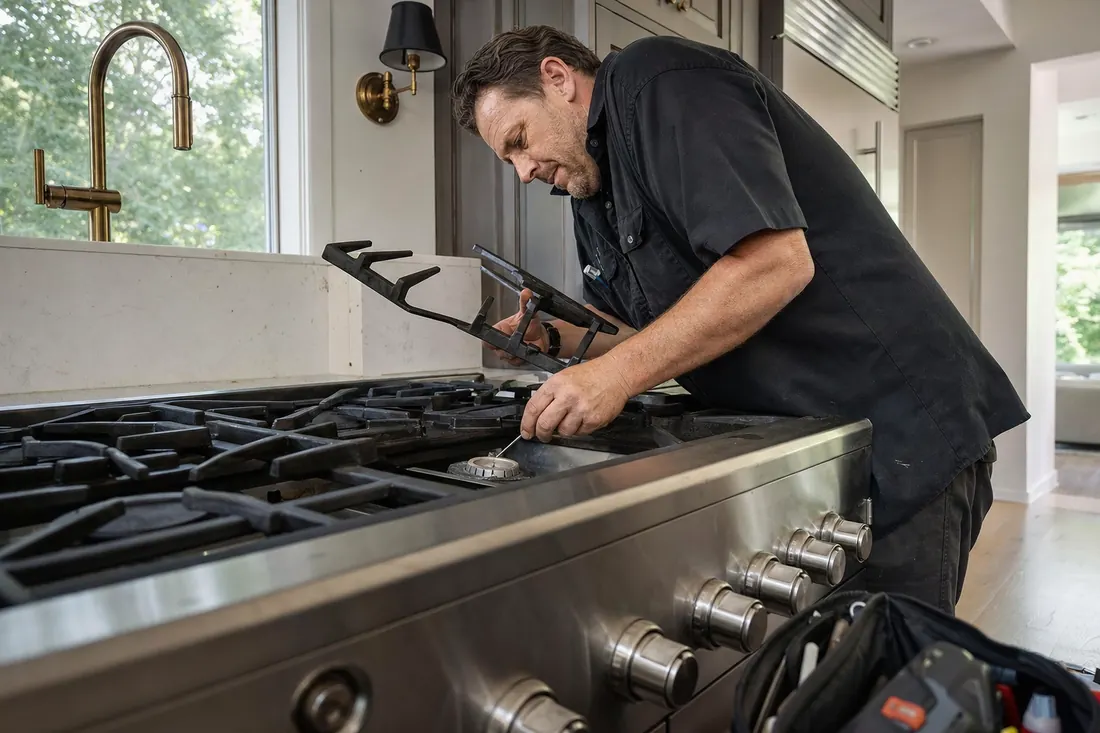
A star burner that clicks without lighting after a humid night is rarely a failed
part. Moisture and cooking residue in the port produce a lazy flame and a burner
that will not catch on the first attempt, and cleaning the port and drying the
electrode resolves it more often than a component does. Where every burner misbehaves
at once, the answer is upstream: the spark module, or gas pressure taken at the
manifold with a manometer rather than judged by the look of the flame.
Steam and combination ovens are a different animal again. The steam half generates
its own failures — a generator that no longer heats, level sensing that misreads, a
solenoid that will not open, or a vent and drain path that leaves the cavity wet at
the end of the cycle — and the cavity seal is what makes any of it work. A door that
has dropped out of square or a gasket that has taken a set lets steam into the
cabinetry around the oven, which becomes a joinery problem as well as an appliance
one.
Wall ovens get measured rather than argued with. We log cavity temperature with an
independent probe through a full cycle and compare it against the set point before
deciding whether the sensor, the calibration, the element or the door is at fault —
four causes for one complaint, at four very different prices.
Freedom columns and the humidity problem
Thermador’s column refrigeration is fully integrated and panel-ready, and the doors
carry heavy custom fronts. Two consequences follow in this climate.
First, a heavy door on a tall column loads its hinges hard. When alignment goes,
the gasket stops sealing evenly, and at a 70-degree dew point the seam sweats.
Homeowners report condensation on the cabinet face and a musty smell long before
the temperature moves.
Second, a column is a single-purpose appliance — one is a refrigerator, one is a
freezer, and they run independently. A freezer column holding perfectly while the
refrigerator column climbs is not a mystery; it is one circuit needing attention,
and the other one is fine.
Cooking-side symptoms worth naming
Star burners that click and do not light after a humid night are usually a wet
electrode, not a failed spark module. Induction elements that cut out partway
through a sear are usually thermal — the electronics under the glass are cooled by
a fan, that fan draws room air, and room air in a Florida kitchen carries dust.
Ovens that bake long need the cavity measured with an independent probe over a full
cycle before anyone orders a part.
How we work on them
The visit starts at an $80 flat diagnostic, credited toward the repair once you
approve it, with a written estimate before any part is ordered. Genuine OEM parts,
90 days on labor, 365 days on parts. Where the real fix is water treatment rather
than a component, we will tell you that instead of selling you a part.