Skip to content

Independent · Multi-brand

Northeast Florida

Mon–Fri 8–6 · Sat 9–4

Before · during · after

Questions, answered in order

The questions below are the ones we are actually asked, grouped by where they fall in a repair. Where an answer depends on a figure, the figure is published and sourced rather than rounded into a slogan.

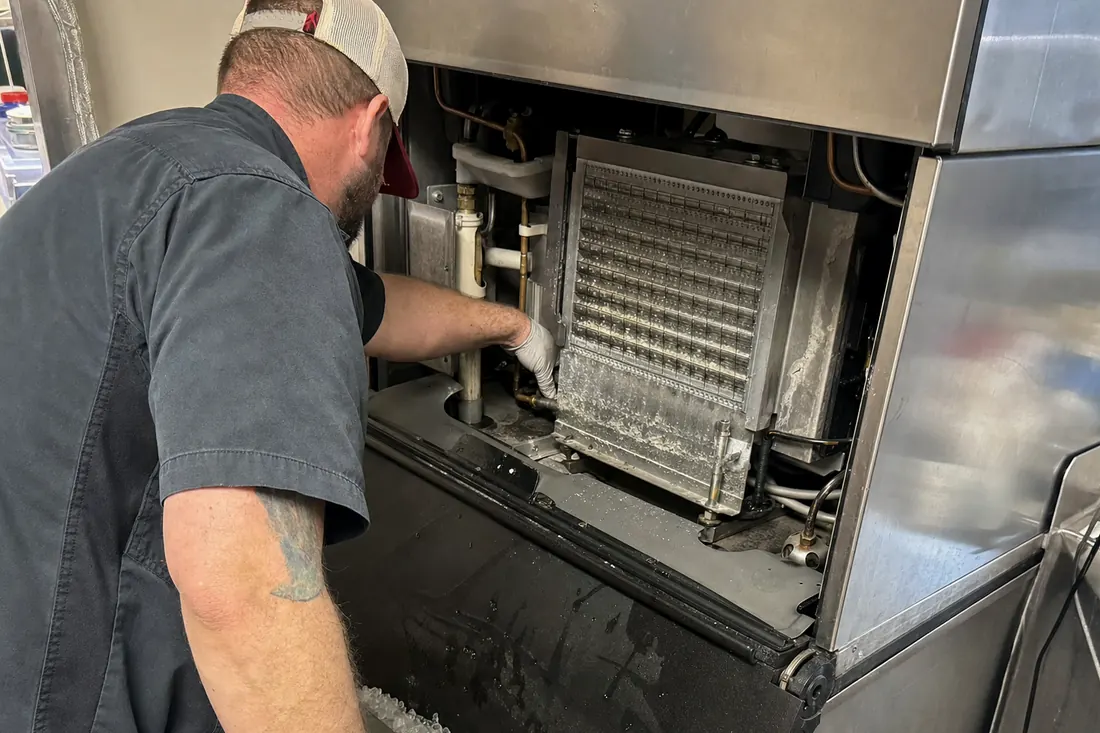
Technician at a stainless ice machine with the top panel off, checking the water line and the evaporator plate, mineral scale on the metal in frame - Questions, answered in order
The money, first

Do you charge by the hour?

No, and no hourly rate is published here because we do not bill one. The visit is a flat $80 however long the diagnosis takes, and the repair is then quoted as a job, parts and labor together and in writing. A fault that hides for an hour costs you nothing extra.

Why is one quote higher than another on the same symptom?

The component decides it, not the badge on the door. "Not cold enough" is door gasket or seal replacement at $240–$600 on one visit and compressor or sealed-system repair at $930–$2,520 on the next. Access adds to it: a column sealed into cabinetry takes longer to reach than a unit that rolls out.

What is the most expensive part to replace on a refrigerator?

The compressor, and the sealed system around it. Compressor or sealed-system repair runs $930–$2,520 in this market, which is more than double electronic control board at $440–$990 and several times door gasket or seal replacement at $240–$600. Nothing else inside the cabinet costs what the part that makes it cold costs.

Is it ever worth repairing a built-in dishwasher?

Usually, because the failures we are called to are small against the machine. Dishwasher pump or control runs $240–$660 and electronic control board $440–$990. Replacement starts to win when the tub or the door frame has corroded through, or when a custom panel makes the swap a cabinetry job as well.

How long should built-in equipment last on this coast?

We publish no lifespan figure, because we have not measured one and the coast decides it anyway. The trade generally observes that built-in equipment outlives a freestanding equivalent by years. What shortens it here is salt on the condenser fins, heat rejected into a closed cabinet all summer, and storm-season transients reaching the board.

Before you call

Are you affiliated with the manufacturers you name?

No. We are an independent appliance repair company and we hold no appointment from any manufacturer. Naming a brand on this site identifies an appliance we repair, nothing more. If you want manufacturer-appointed service, the maker's own website lists who holds that appointment in your ZIP code, and you should use it — checking takes about a minute.

Which brands do you actually work on?

Six lines, listed on the brands page, covering built-in refrigeration, ice machines, dishwashers, wall ovens, ranges, cooktops and ventilation. We would rather say no to a brand we do not carry parts and documentation for than learn it on your kitchen floor.

Do you do heating or air conditioning?

No. We repair built-in kitchen appliances — refrigeration, ice machines, dishwashers, wall ovens and ranges, cooktops and ventilation — and nothing else. Furnaces, air handlers, heat pumps and ductwork are a different trade with a different licence, and a licensed HVAC contractor is who you want for those. Laundry is not ours either. The overlap in vocabulary is real and it misleads people: a refrigerator has a condenser and so does an air conditioner, but they are not the same machine and we only open one of them.

Do you charge to come out?

$80 flat diagnostic fee, credited toward the repair when you approve the work. There is no separate call-out charge stacked on top of it, no booking fee and no charge for the phone conversation.

Can you quote the repair before you see it?

Not honestly. "It is not cold enough" is a blocked condenser on one visit, a door that has dropped out of square on the next and a failed defrost heater on the third, and those three repairs are nothing like each other in cost. We diagnose, then quote in writing, then you decide.

Do you offer emergency or 24-hour service?

No, and we do not advertise it. We run scheduled appointments — Mon–Fri 8–6 · Sat 9–4 — because a slot we can actually keep is worth more than a promise we would miss on the third day after a storm.
During the visit

What does the diagnostic actually involve?

Measurement rather than assumption. Cavity temperatures logged through a full cycle on an oven, sealed-system pressures where refrigeration is in question, gas pressure taken at the manifold rather than guessed at the burner, and the installation itself checked — clearance, levelling, drain routing and circuit. A surprising number of "faulty appliance" calls end at the installation.

Will you have the part on the van?

Sometimes. Common failure items for the lines we carry ride with us; board-level and model-specific components are ordered against the written estimate once you approve it. Giving us the model and serial number when you book is what decides which of those two afternoons you get.

Do you use genuine parts?

Genuine OEM parts only. Built-in equipment runs tight tolerances and control logic that aftermarket substitutes do not reliably reproduce, and a mismatched board or valve tends to fail again inside a year.

What if the answer is that it is not worth repairing?

Then we say so, in writing, with the reasoning. In the historic river neighbourhoods there is a second question behind it: whether a modern replacement will physically fit an opening built in the 1920s. We measure the opening during the diagnostic rather than after you have ordered something.

After the repair

How long is the work warranted?

90 days on labor, 365 days on parts, genuine OEM parts only. A warranty return is scheduled ahead of new bookings. The exclusions — a different fault on the same appliance, surge damage, coastal corrosion — are set out in full on the warranty page.

Why is my ice machine making less ice every summer?

Usually heat rejection rather than the ice side of the machine. An undercounter unit rejects its heat through a fin stack behind the plinth grille, and that stack collects dust, pet hair and, in a garage or an outdoor kitchen, whatever else is in the air. As it loads up, the freeze cycle lengthens, production falls and the compressor runs longer for less. Clearing the grille and the fin stack on a schedule is the single most useful thing an owner can do.

My appliance died after the power came back. Is that covered by anything?

That timing is the norm, not a coincidence: control boards fail on the restoration surge rather than during the outage. It is storm damage, so it is a homeowner insurance question rather than a repair warranty question. The habit that prevents most of it is opening the breaker once the power is already out and restoring it manually twenty minutes after the street is stable.

Do you cover my address?

Roughly a 40-mile working radius from the Jacksonville core. That takes in Duval County, St. Johns County, Clay County, Nassau County. If you are on the edge of it, call and ask — the answer depends on the day's routing, and we would rather tell you no than take a booking we cannot keep.

Customer feedback

Answers from the other side of the visit

Rated 4.6 out of 5 across 101 customer reviews. Every entry below is one appointment, written up afterwards by the householder whose kitchen it happened in.

Three published entries, filed under the equipment and the area each visit concerned.

  • An element on the induction top was cutting out under load. It turned out to be thermal rather than electrical, which he demonstrated with a thermometer rather than asking me to take his word for it.

    Jocasta W.2026-04-25

  • The wine cabinet held a couple of degrees warm and the thermistor was reading badly. The part took a good deal longer to arrive than I was led to expect and I chased it twice, but the temperature has been flat since it went in.

    Dashiell M.2025-11-18

  • The outdoor kitchen unit filled and then did nothing. Harvest thermostat had drifted and the drain was silted up with salt and sand. He replaced the one part, flushed the line and it has cycled properly ever since.

    Wilhelmina O.2026-07-16

More of the 101 published entries

What it costs

What does the work itself cost?

One fee to find out: $80, flat, and it comes off the bill the moment you say go ahead. Past that, repair work across this coast sits between $240 and $2,520, and where inside that band a job lands is decided by the part that failed rather than by the badge on the door.

Four of the commonest repairs, so an answer above that turns on money can be checked against a figure. The whole table is on the pricing page.

Parts and labor by repair, repair. A band, not a price tag: it is where work of this kind lands in this market, and your own figure goes in writing once the appliance has been measured.
Repair Parts and labor
Diagnostic visit, flat $80
Compressor or sealed-system repair $930–$2,520
Electronic control board $440–$990
Door gasket or seal replacement $240–$600
Dishwasher pump or control $240–$660

You get a written estimate before any part is ordered or any labor begins. Nothing proceeds without your approval.

Still unanswered

Reference material on this site is organised four ways: by manufacturer, by equipment type, by where you live, and by what the season is doing. The pricing and warranty pages carry the commercial terms in full.