Hurricane outages: the damage comes back with the power — what is the short version?
A multi-day outage rarely kills an appliance. The coordinated restoration that ends it does, and there is a simple habit that prevents most of it.
Independent · Multi-brand
Northeast Florida
Mon–Fri 8–6 · Sat 9–4
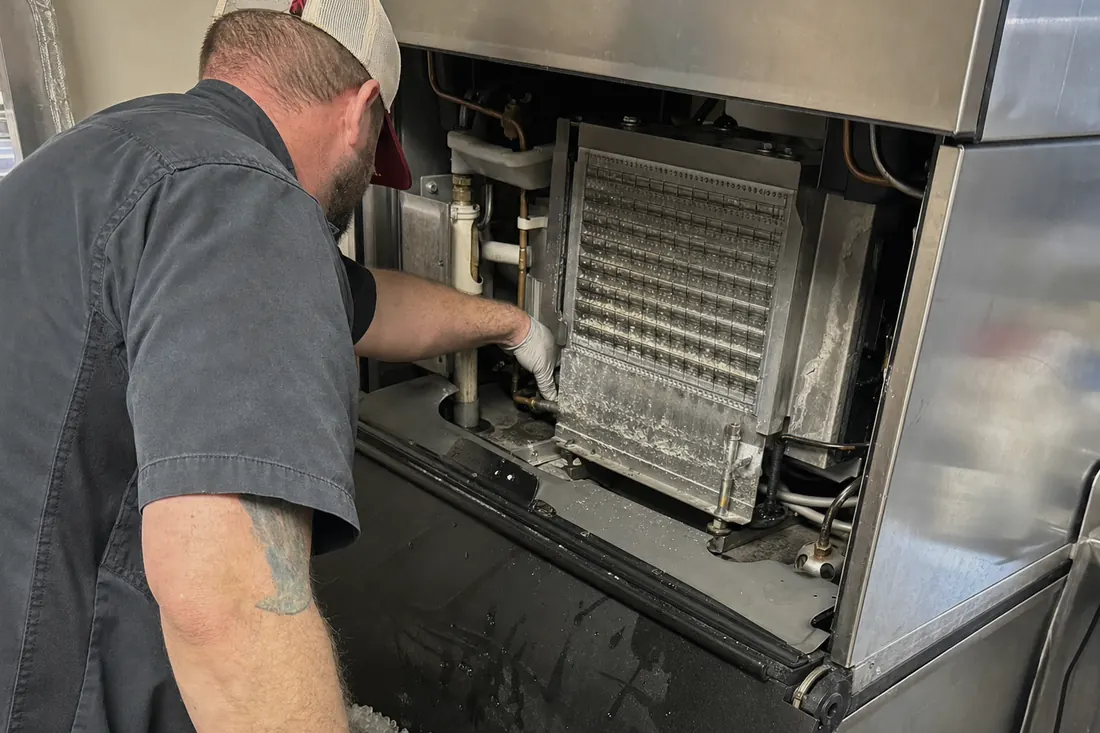
Clean the condenser on every built-in refrigerator and ice machine in the house. Check gasket compression at four points on each door. Turn the refrigerator and freezer down a step or two so there is thermal margin banked before anything happens. Photograph the model and serial plate on each appliance while the lights are on — that plate is inside a door or behind a grille and it is unreadable by torchlight in a hot kitchen.
Keep refrigeration doors shut. A well-sealed built-in holds temperature for hours without help. Then, once the power is genuinely out, open the breakers for the refrigeration, the range or wall oven, and the ice machine, or unplug what you can reach. Nothing in a dark house needs to be connected, and everything connected is exposed when the grid returns.
Let the street run for about twenty minutes before you restore anything — early restoration is unstable and it is common to see it drop again. Bring appliances back one at a time. Give refrigeration several hours to pull down before judging it. If a unit hums and cuts out, will not boot, or lights its interface without responding, stop cycling it and have it looked at; repeated restart attempts damage a compressor that is already struggling.
Homeowners prepare for a hurricane by thinking about food. They should be thinking about voltage.
Northeast Florida has three recent events with verifiable figures. Matthew knocked out power for nearly 250,000 metro customers in October 2016. Irma produced the worst Jacksonville flooding in nearly a century in September 2017. Helene took 113,000 JEA customers off the grid in September 2024.
In each case, our call volume did not spike during the outage. It spiked in the week after restoration, and the calls were not about spoiled food. They were about refrigerators that would not restart, ovens with one element dead, ice machines that had gone silent, and control panels that lit up and then ignored every button.
An appliance sitting on a dead circuit is doing nothing and cannot be harmed. The harm arrives when a utility re-energises a whole area at once.
Restoration is not a clean switch. Voltage can arrive high, sag under sudden aggregate load, drop out and return, and swing while the system rebalances. That sequence is exactly the kind of event that damages electronics: not one dramatic strike, but repeated transients across a few minutes.
Three things in a modern kitchen are particularly exposed.
Control boards. Every built-in refrigerator, wall oven, dishwasher and ice machine has one. They tend to fail selectively rather than completely — one relay stops closing, one display segment goes dark, one function stops responding — which is why the fault often reads as random.
Inverter compressor drives. Variable-speed compressors are driven by power electronics. That drive is the expensive part of the appliance and it is the part that a surge finds first. A compressor that hums and trips shortly after restoration is very often a drive problem, not a mechanical one.
Anything with a display that stays powered. If a device is showing a clock while the house is dark, it is on a battery or a standby supply, and its logic board is still connected to the circuit.
A point-of-use surge protector is fine and it is worth having. It is also sized for a fast, high-energy spike, and the restoration event is often a longer sagging and swinging condition that a clamping device does not address at all. A whole-house surge protective device at the panel is a genuine improvement and worth discussing with an electrician. Neither one is as reliable as an open breaker.
Do not keep flipping the breaker to see whether the refrigerator will start this time. A compressor that is failing to start draws locked-rotor current every attempt, and every attempt heats the windings further.
Do not run built-in refrigeration off a small generator through an extension cord without knowing the generator’s output quality. Inexpensive non-inverter generators produce a waveform that variable-speed compressor drives handle poorly, and running one for three days can do what the outage did not.
Do not judge a refrigerator in the first hour. A built-in unit that has been off for two days needs several hours to pull down. Empty compartments and hot food in them both extend that.
Call once power has been stable for a day and something is still wrong: a unit that will not start, an interface that does not respond, an oven element that is dead, a compressor that cycles on and off within a minute, or an ice machine that runs without producing.
The visit is an $80 flat diagnostic, credited toward the repair when you approve the work, with a written estimate before any part is ordered. Sealed-system work is run by an EPA Section 608 certified technician. Genuine OEM parts, 90 days on labor, 365 days on parts.
We are an independent appliance repair company. We schedule appointments Monday to Friday 8am to 6pm and Saturday 9am to 4pm — we do not advertise emergency or 24-hour service, and in the week after a storm we would rather tell you honestly when we can be there.
One fee to find out: $80, flat, and it comes off the bill the moment you say go ahead. Past that, the repair work this guide describes sits between $280 and $2,520, and where inside that band a job lands is decided by the part that failed rather than by the badge on the door.
Narrowed to the failures this guide is about, so the table is shorter than the one on the pricing page.
| Repair | Parts and labor |
|---|---|
| Diagnostic visit, flat | $80 |
| Electronic control board | $440–$990 |
| Compressor or sealed-system repair | $930–$2,520 |
| Evaporator or condenser fan motor | $280–$600 |
You get a written estimate before any part is ordered or any labor begins. Nothing proceeds without your approval.
A multi-day outage rarely kills an appliance. The coordinated restoration that ends it does, and there is a simple habit that prevents most of it.
$80 to come out and find the fault, credited back the moment the repair is approved. The work itself lands between $280 and $2,520 on this kind of equipment — $440–$990 for electronic control board, $280–$600 for evaporator or condenser fan motor — and which of those it turns out to be is the thing the visit settles. Your own number goes in writing before a part is ordered.
The model and serial number off the data plate, the address, and what the appliance is actually doing rather than what you think has broken. The serial matters more than the model: built-in equipment is revised mid-production, and it often decides which board, gasket or motor is the correct one.
Rated 4.6 out of 5 across 101 customer reviews. Every entry below is one appointment, written up afterwards by the householder whose kitchen it happened in.
Filed under the equipment this guide is about, so these are visits to the failure described above.
After the August outage the column came back on but never pulled down past the mid forties. He found the compressor start components cooked by the restoration surge and swapped the whole relay pack. It holds temperature again.
Halcyon B.2025-09-08
Our refrigerator had begun ticking and then running very long. He traced it to a fan hitting a bracket that had shifted, refitted it and cleaned the coil. Quiet, and the run times came back down.
Tiberius N.2026-03-31
Frost kept rebuilding on the rear wall every few weeks. The defrost heater read open and the drain trough was packed solid. Both were dealt with, although the correct heater for our serial meant a second appointment.
Thaddeus K.2026-05-06
You get a written estimate before any part is ordered or any labor begins. Nothing proceeds without your approval.