Salt air and coastal appliance corrosion — what is the short version?
Chloride does not tarnish stainless evenly, it pits it locally. On the coast that mechanism sets the whole maintenance schedule.
Independent · Multi-brand
Northeast Florida
Mon–Fri 8–6 · Sat 9–4
Fresh water on exposed stainless and on condenser fin stacks, once a month, on any outdoor kitchen or garage unit in a coastal ZIP. Rain does not do this for you — it dissolves deposited salt and carries it into seams and fastener threads where it stays. A hose and five minutes is the entire method and it is more effective than anything else on this page.
Work every hinge, every drawer runner and every damper on the equipment you have outdoors, and look for stiffness rather than for rust. Stiffness comes first. A hinge that has started to bind is still repairable; a hinge that has seized and been forced has usually taken the door alignment with it, and a door out of alignment is a sealing problem within a season in this humidity.
Pitting on stainless is localised damage to the passive oxide layer and it does not polish out the way surface tarnish does. What matters at that point is stopping the progression: clean the affected area, keep chloride off it, and check whether the same exposure has reached the condenser fins and the fasteners where the consequences are functional rather than cosmetic.
The coastal ZIPs in our service area are 32082 in Ponte Vedra Beach, 32250 in Jacksonville Beach, 32266 in Neptune Beach, 32233 in Atlantic Beach and 32084 in St. Augustine. Close enough to the Atlantic that airborne chloride is a daily, continuous load rather than an occasional storm event.
Inland Jacksonville does not have this problem in the same way. Queen’s Harbour and other Intracoastal addresses sit somewhere in between. If you are on the water, this page is about your equipment; if you are inland in Deerwood or Mandarin, the summer heat-load guide is more relevant to you.
This is the part homeowners find surprising. Salt air does not make a refrigerator run warm by interfering with the cooling. It attacks the metal the appliance is made of, and the cooling problem is downstream.
Stainless steel pits rather than tarnishes. Stainless resists corrosion because of a very thin passive oxide layer that reforms whenever it is disturbed. Chloride ions are specifically effective at breaking that layer down in localised spots and preventing it from reforming there. The result is pitting — small, deep, discrete sites of attack, often with rust bloom around them — rather than the even dulling people expect from weathering. It appears first at handles, seams, weld lines and screw heads.
Fasteners and hinges seize. Wherever two dissimilar metals are in contact and a chloride-bearing electrolyte is present, you have a galvanic cell, and the less noble metal corrodes preferentially. In practice that means hinge pins bind and then seize, screw heads corrode until they round out under a driver, and a door that has to be forced comes out of alignment.
That last consequence is the expensive one, and it is why this guide sits next to the humidity guide. A refrigerator door that no longer closes square does not seal evenly. In a climate at 75 percent mean relative humidity, an unsealed door means condensation at the seam, mould in the gasket folds, and a defrost system falling behind a continuous ice load. A hinge problem becomes a sealed-system symptom.
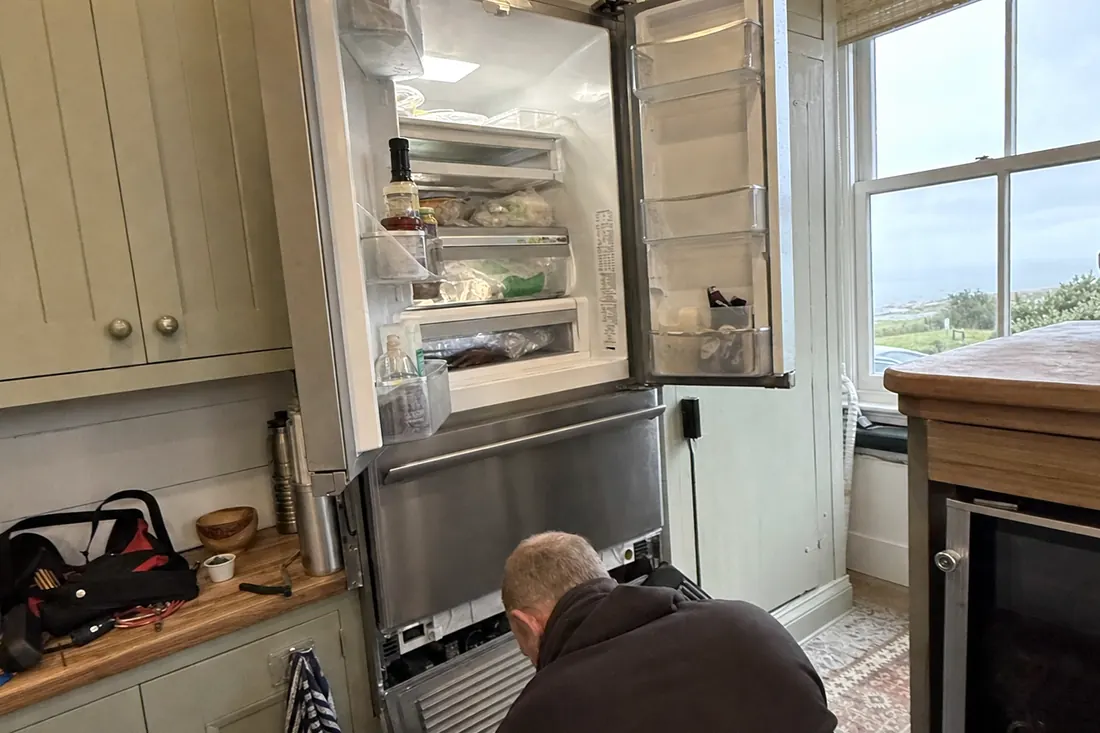
Condenser fins corrode and capacity falls. Condenser fin stacks are usually aluminium, and aluminium in a salt environment corrodes readily. The stack loses surface area, heat rejection drops, run time climbs, and output falls. On an outdoor refrigerator or ice machine at a beach property, this is the most common cause of a unit that “just isn’t as cold as it used to be” — and it develops slowly enough that nobody can name a day it started.
Summer kitchens are common on coastal lots here, and outdoor equipment gets the whole load at once: chloride on the stainless, chloride on the fasteners, chloride on the condenser, plus ambient air in the nineties in August that the same condenser is trying to reject heat into. An outdoor refrigerator or ice machine in that situation has very little margin, and a fin stack that is even slightly compromised pushes it over.
Ventilation gets caught too. Exterior hood dampers on coastal houses seize with corrosion, and a stuck damper produces symptoms identical to a failing blower — the motor sounds normal and the hood pulls nothing. We check the exterior termination from outside as part of the diagnosis rather than assuming the wheel.
Rinsing works, and it is boring, and it is the answer. Fresh water on exposed stainless and on condenser fin stacks monthly. Keeping covers on outdoor equipment when it is not in use, but not sealing damp salt underneath a cover. Working hinges and runners so binding is caught before seizing. Replacing corroded fasteners with appropriate stainless hardware rather than driving a rounded screw harder.
None of that is a repair, which is why nobody sells it to you.
Call when a door has stopped closing square, when an outdoor unit’s output has dropped through the summer, when a hood has lost capture, or when a hinge or runner has seized. We are an independent appliance repair company, working scheduled appointments Monday to Friday 8am to 6pm and Saturday 9am to 4pm.
$80 flat diagnostic, credited toward the repair on approval, written estimate before any part is ordered, genuine OEM parts, 90 days on labor, 365 days on parts.
One fee to find out: $80, flat, and it comes off the bill the moment you say go ahead. Past that, the repair work this guide describes sits between $200 and $570, and where inside that band a job lands is decided by the part that failed rather than by the badge on the door.
Narrowed to the failures this guide is about, so the table is shorter than the one on the pricing page.
| Repair | Parts and labor |
|---|---|
| Diagnostic visit, flat | $80 |
| Igniter, spark module or surface element | $200–$570 |
You get a written estimate before any part is ordered or any labor begins. Nothing proceeds without your approval.
Chloride does not tarnish stainless evenly, it pits it locally. On the coast that mechanism sets the whole maintenance schedule.
$80 to come out and find the fault, credited back the moment the repair is approved. The work itself lands between $200 and $570 on this kind of equipment — $200–$570 for igniter, spark module or surface element — and which of those it turns out to be is the thing the visit settles. Your own number goes in writing before a part is ordered.
The model and serial number off the data plate, the address, and what the appliance is actually doing rather than what you think has broken. The serial matters more than the model: built-in equipment is revised mid-production, and it often decides which board, gasket or motor is the correct one.
Rated 4.6 out of 5 across 101 customer reviews. Every entry below is one appointment, written up afterwards by the householder whose kitchen it happened in.
Filed under the equipment this guide is about, so these are visits to the failure described above.
The refrigerator side drifted warm while the freezer stayed hard. He measured the evaporator fan pulling almost nothing, traced it to a failed motor, and cleared the drain while the panel was off. Cold within the hour.
Quentin A.2026-08-26
Beads of water kept forming along the centre post between the two doors. Rather than sell me a whole door he tested the heater in the mullion, found it open circuit, and replaced that one part. Dry ever since.
Ambrose W.2026-02-11
An old Riverside kitchen where the refrigeration had been fitted into an opening that predates it. He measured the airflow around the cabinet first, then cleaned the condenser and replaced the fan that had seized.
Ottilie H.2026-05-25
You get a written estimate before any part is ordered or any labor begins. Nothing proceeds without your approval.