Summer heat load, and the condensers that give up — what is the short version?
Refrigeration does not make cold, it moves heat. From June onward there is nowhere cool to put it, and the appliance with a loaded condenser is the one that fails.
Independent · Multi-brand
Northeast Florida
Mon–Fri 8–6 · Sat 9–4
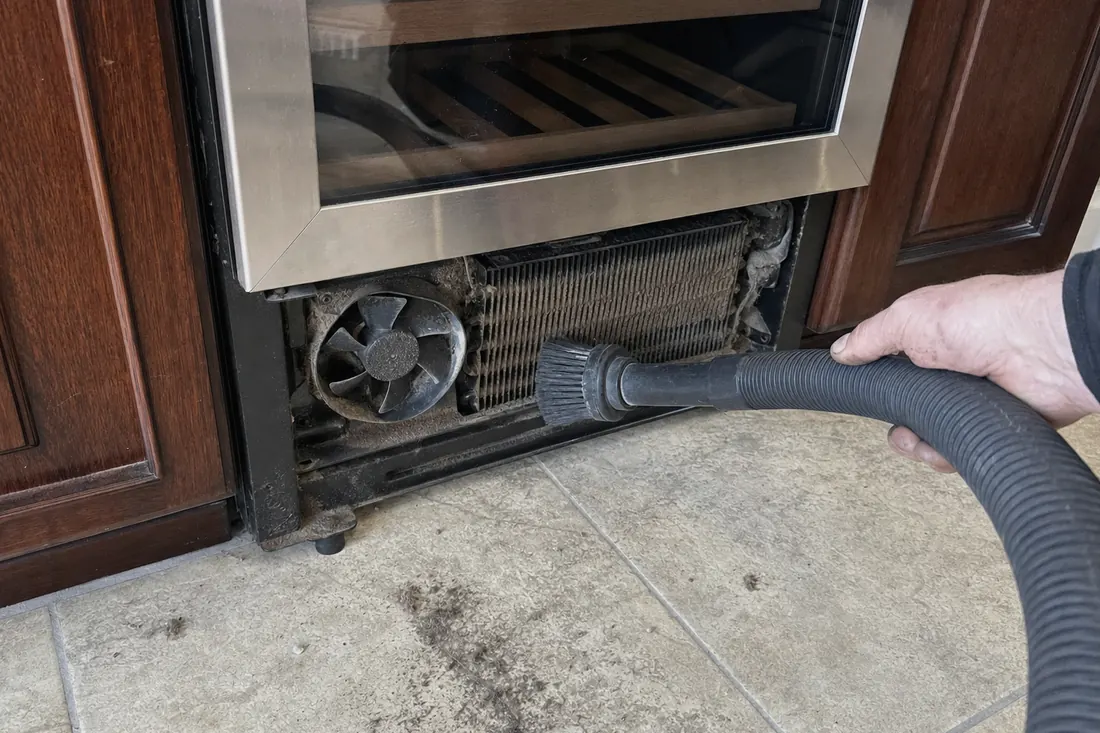
The most useful thing an owner can do costs nothing. Pull the toe or plinth grille off the refrigerator, the freezer column and the undercounter ice machine, look at the fin stack behind it, and clear the dust, pet hair and lint out with a soft brush and a vacuum rather than a blast of compressed air, which drives the debris further in. Do it before the hot months rather than during them.
A sealed system in trouble almost always tells you by running longer before it tells you by getting warm. Note when the compressor is audibly running and when it is not. A unit that used to rest and now never seems to, while still holding temperature, is the one to book. Once it stops holding temperature the food is already at risk and the diagnosis has not changed.
Do not keep cycling it off and on to see whether it recovers. Repeated short-cycling loads a compressor that is already working against high head pressure, and it turns a cleanable condenser into a component failure. Move what matters to another appliance, leave the doors closed, and have it looked at before the next hot afternoon.
It moves heat. A sealed system collects heat from inside the cabinet, carries it in the refrigerant, and rejects it into the room through the condenser. That last step is the one the weather interferes with, because rejecting heat requires somewhere cooler to put it, and from June to September this region does not reliably supply one — not in the afternoon, and not overnight either.
The consequence is arithmetic rather than opinion. As the air around the condenser gets hotter, the pressure the compressor works against rises, the amount of heat each cycle moves falls, and run time climbs to make up the difference. A system that is otherwise perfect loses capacity in hot air. A system with anything else wrong with it — a loaded fin stack, a stalled fan, a door that no longer seals — loses enough capacity to present as a fault.
That is why the same appliance can behave impeccably from November to April and be “broken” by the second week of July. Nothing changed inside it. The margin it had been running on disappeared.
Free-standing appliances reject heat off the back into an open room. Built-in and column equipment cannot: it is sealed into cabinetry on three sides, so the whole airflow path is designed to run through a grille — usually at the plinth, sometimes at the top of the column — across the fin stack, and back out into the kitchen.
Three things break that path, and they break it in this order of likelihood.
The grille is blocked or the fin stack is loaded. Dust, pet hair and cooking aerosol collect on the fins and act as insulation on the one surface whose entire job is to shed heat. This is the most common cause of a summer refrigeration call, and it is not a parts failure at all.
The condenser fan is not moving air. It may have failed outright, it may be stalled against debris, or its shroud may have been knocked out of position during a cabinet or flooring job, so it turns freely and moves nothing usefully across the stack.
The unit is re-breathing its own discharge. Where a cabinet opening is tight, a plinth has been boxed in during a remodel, or the return path behind the appliance has been blocked, warm discharge air is drawn straight back into the intake. The appliance is then rejecting heat into air it has already heated.
A second refrigerator or freezer in an unconditioned garage is common here, and it is the appliance most likely to fail quietly at the worst moment. Domestic refrigeration is specified to work within a range of ambient room temperatures, and an unconditioned garage through a Northeast Florida summer spends whole afternoons outside that range.
The same applies to outdoor kitchens. An undercounter refrigerator or ice machine under a counter in afternoon sun is rejecting heat into hot, still air in a confined space, with a fin stack collecting whatever the outdoors offers. Where an appliance was not built for an outdoor installation, summer is when that difference stops being theoretical.
Ice machines feel it fastest of anything in the house. Every batch has to be frozen and then released by warming the plate, so the machine is cycling heat in both directions all day. Lose condenser capacity and both halves of that cycle lengthen: production falls, run time climbs, and the bin stops filling overnight in exactly the month the ice is wanted.
A range hood is not only a smoke extractor here. It removes the heat and moisture a cooktop adds to a room that is already warm, and a blower wheel loaded with cooking grease loses capture progressively rather than suddenly — nobody notices the month it stopped working, only the season.
Ovens have their own version of it. The cooling fan that keeps heat off the control electronics runs during and after a bake cycle, and a door that no longer closes flush washes hot air over the control panel every time the oven is used. Electronics tolerate that for a while and then stop tolerating it.
The order matters, because it runs from cheapest to most expensive and because stopping early is usually the honest answer.
A large share of summer calls end at step one or step three. We would rather tell you that and charge the diagnostic than open a sealed system that did not need opening.
Built-in and column equipment is worth maintaining in a way a free-standing appliance often is not. It is expensive, it is fitted to a specific cabinet opening, and a replacement has to fit that opening or the cabinetry changes with it. A condenser cleaned on a schedule protects the most expensive component in the box — the compressor — and compressor replacement on a built-in is the repair most likely to tip a decision toward replacement instead.
We are an independent appliance repair company. $80 flat diagnostic, credited toward the repair on approval, written estimate before any part is ordered, genuine OEM parts, 90 days on labor, 365 days on parts.
One fee to find out: $80, flat, and it comes off the bill the moment you say go ahead. Past that, the repair work this guide describes sits between $240 and $2,520, and where inside that band a job lands is decided by the part that failed rather than by the badge on the door.
Narrowed to the failures this guide is about, so the table is shorter than the one on the pricing page.
| Repair | Parts and labor |
|---|---|
| Diagnostic visit, flat | $80 |
| Evaporator or condenser fan motor | $280–$600 |
| Compressor or sealed-system repair | $930–$2,520 |
| Ice maker, water valve or supply line | $240–$670 |
You get a written estimate before any part is ordered or any labor begins. Nothing proceeds without your approval.
Refrigeration does not make cold, it moves heat. From June onward there is nowhere cool to put it, and the appliance with a loaded condenser is the one that fails.
$80 to come out and find the fault, credited back the moment the repair is approved. The work itself lands between $240 and $2,520 on this kind of equipment — $280–$600 for evaporator or condenser fan motor, $240–$670 for ice maker, water valve or supply line — and which of those it turns out to be is the thing the visit settles. Your own number goes in writing before a part is ordered.
Monday – Friday 8:00am – 6:00pm and Saturday 9:00am – 4:00pm. Scheduled appointments only. We do not advertise 24-hour or emergency service. We would rather tell you the truth about the diary than promise a window we would then miss, and there is no out-of-hours premium because there is no out-of-hours service to charge one for.
Rated 4.6 out of 5 across 101 customer reviews. Every entry below is one appointment, written up afterwards by the householder whose kitchen it happened in.
Filed under the equipment this guide is about, so these are visits to the failure described above.
The wine cabinet held a couple of degrees warm and the thermistor was reading badly. The part took a good deal longer to arrive than I was led to expect and I chased it twice, but the temperature has been flat since it went in.
Dashiell M.2025-11-18
The unit barely stopped running and the cabinet side was hot to touch. The condenser was blanketed in dust from a return that sits right beside it. He stripped and cleaned the fin stack and the cycling was normal by evening.
Ottoline R.2026-01-22
After the August outage the column came back on but never pulled down past the mid forties. He found the compressor start components cooked by the restoration surge and swapped the whole relay pack. It holds temperature again.
Halcyon B.2025-09-08
You get a written estimate before any part is ordered or any labor begins. Nothing proceeds without your approval.