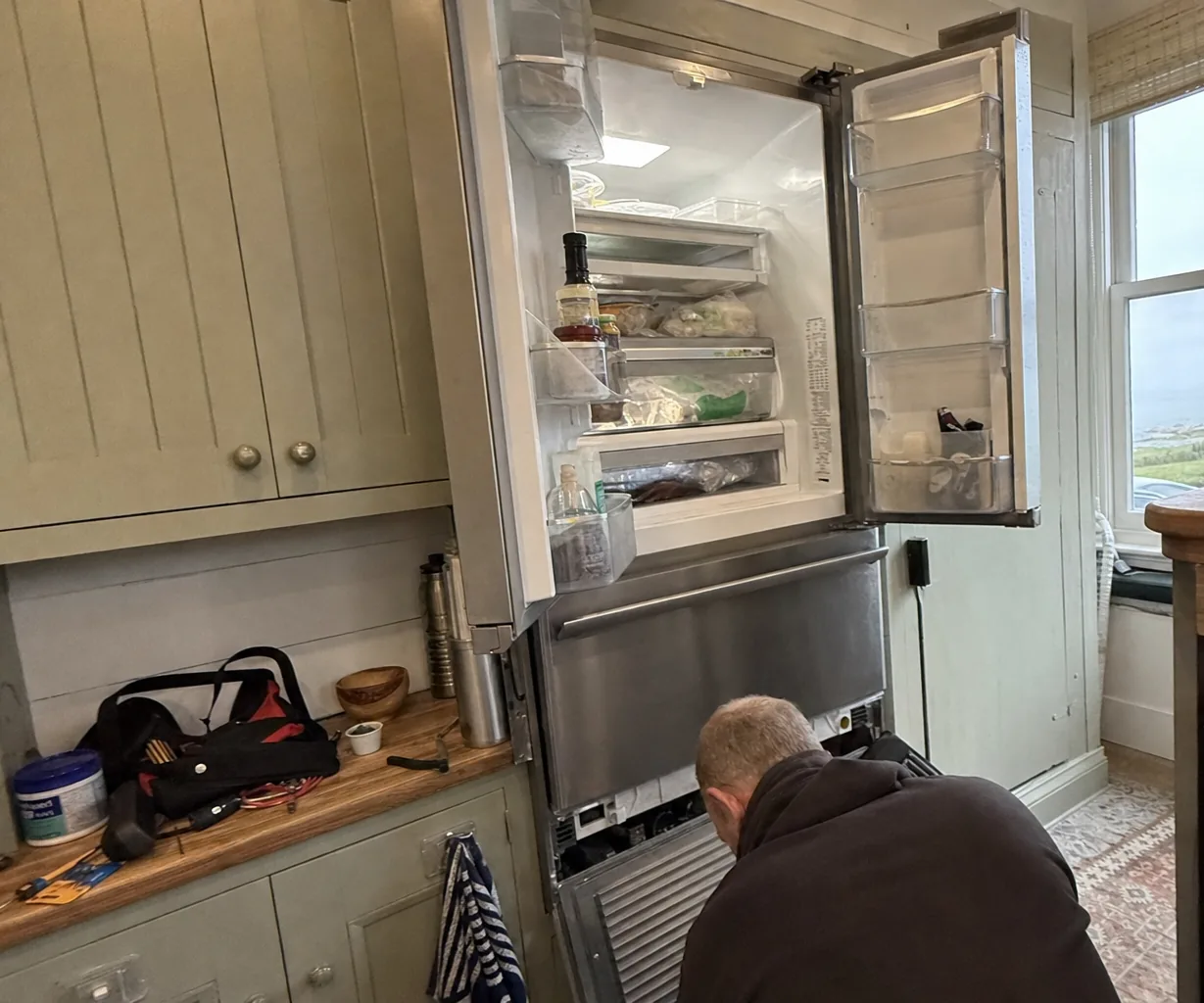
In a Bosch vs Sub-Zero refrigerator decision, the short answer is that Sub-Zero is a cold-storage specialist whose Classic models run separate refrigerator and freezer systems and are made to be built into cabinetry, while Bosch builds refrigerators as one part of a full kitchen lineup, usually at a lower purchase price, and backs its built-in models with several years of written parts coverage. Pick Sub-Zero when food preservation and a fully integrated look come first. Pick Bosch when you want a well-made fridge that matches a Bosch dishwasher or range and keeps the budget in check.
Two different kinds of company
Sub-Zero makes refrigeration and nothing else. Its current families are Classic, Designer and PRO, names that date from March 2019, when the company retitled its Built-In series as Classic and its Integrated series as Designer while PRO stayed as it was. An older manual that says Built-In or Integrated is describing the same two families.
Bosch comes at the kitchen from the other side. Refrigerators sit alongside its dishwashers, wall ovens, ranges and cooktops, so a Bosch fridge is often chosen to match appliances already in the room. Its B36CL fridge-freezer, used as the example below, has a straightforward layout, a filtered water supply and controls you can learn in an afternoon.
Cooling design and how each fits the cabinets
The biggest engineering difference is inside the box. In the Sub-Zero Classic line, Dual Refrigeration gives the fresh-food side and the freezer a cooling system each. Because the compartments never trade air, smells from leftovers stay away from the ice and frozen food, and the refrigerator keeps its humidity instead of having that moisture pulled out and frozen. That is kinder to lettuce, herbs and soft fruit.
Fit is the second difference. Sub-Zero steers owners toward Classic when the unit will stand on its own or have a side partly on show, and toward Designer when the refrigerator should vanish behind cabinet panels with very little metal visible. Classic is offered at 30, 36, 42 and 48 inches wide with a grille across the top that flips up; Designer comes at 24, 30 and 36 inches wide with its grille down near the floor.
Bosch keeps everyday control simple. The B36CL manual suggests 37 °F (3 °C) for the refrigerator and 0 °F (-18 °C) for the freezer, sensible targets on any brand. It also has a Sabbath mode: hold the vacation key for 10 seconds to start it, hold the alarm key for 5 seconds to end it, and if nobody does, the fridge goes back to normal by itself after roughly 80 hours.
Filters and upkeep owners can handle
On a Bosch with a water dispenser or ice maker, the filter is the item owners most often forget. The B36CL manual calls for a fresh cartridge every 6 months, or sooner if the change-filter light comes on or water flow and ice output fall off. After swapping it, hold the change filter key for 3 seconds to clear the reminder. Bosch lists the filter as 11034152 (BORPLFTR10) and also accepts REPLFLTR10 and RA450010 among its compatible numbers.
Sub-Zero upkeep centers on airflow. On a Classic unit, lifting the top grille exposes the condenser, and lint packed into it makes the compressor run longer and hotter, so brush and vacuum it a couple of times a year. On either brand, wipe the door gaskets with warm soapy water and close a sheet of paper in the door; it should drag as you pull it out. In homes near the Jacksonville Beaches, salt air and year-round humidity are hard on stainless trim and rubber seals, so a gasket that has stiffened or split deserves attention early.
Where repairs tend to show up
Neither brand is fragile, and most calls on both involve the same short list of wear parts. A Sub-Zero with two cooling systems has two sets of fans, evaporators and defrost parts, so when one compartment warms up, the other usually keeps going and buys time to save the food. On a single-system fridge-freezer, one fault can hit both sections at once.
| Sign | Probable cause | Owner check | Time for a pro |
|---|
| Milk getting warm while ice stays hard | Evaporator fan or defrost fault | Frost on the rear panel | Frost comes back after a thaw |
| Ice bin filling slowly | Old filter or failing water valve | Filter age and indicator light | Still slow with a new filter |
| Beads of water on the door edge | Worn or twisted gasket | Paper test all the way around | Seal is torn or flattened |
| Both sections running warm | Dirty condenser or weak condenser fan | Clean the condenser area | Still warm a day later |
Sealed-system work on either brand is not a homeowner job, since many newer refrigerators use flammable hydrocarbon refrigerants such as R-600a.
Warranty, parts and what repairs cost
Bosch spells its coverage out plainly. Every Bosch refrigerator gets a 1-year limited warranty on parts and labor. Built-in models add parts-only cover for the entire appliance in the 2nd year, parts-only cover for electronics from the 3rd through the 5th year, and lifetime parts-only protection against rust-through on stainless doors. Parts-only means the part is paid for but not the labor to fit it.
For Sub-Zero, read your own paperwork, since terms vary by model and purchase date, and locate the serial tag before you call. On Classic over-and-under models, including those marked BI or CL, it sits inside the refrigerator door near the top hinge; side-by-sides carry it inside the freezer door, and Classic French-door units inside the left-hand door.
A diagnostic visit is $80, and the firm price follows once the fault is confirmed. Typical ranges are $240–$600 for a door gasket or seal, $280–$600 for an evaporator or condenser fan motor, $240–$610 for a defrost heater, thermostat or sensor, and $240–$670 for an ice maker, water valve or supply line. We fit genuine OEM parts on both brands across Duval, St. Johns and Clay counties.
Which one fits your kitchen
Choose Sub-Zero if the refrigerator is the centerpiece, if you keep a lot of produce, or if you want panels that match the cabinets with almost no steel showing. Choose Bosch if the fridge should match a Bosch dishwasher or range, if cost matters, or if you like coverage written out year by year. If Viking is also on your list, our Sub-Zero vs Viking comparison covers that pairing, and the Bosch and Sub-Zero pages explain what we repair on each.